

How Dr. Atul Shah’s FATE™ Program at NY Food Allergy & Wellness Redefines Desensitization
Food Allergy Desensitization
How Dr. Atul Shah’s FATE™ Program Redefines Food Allergy Desensitization
Food allergy desensitization may raise the amount of an allergen a patient can tolerate before reacting. The FATE™ Program at NY Food Allergy & Wellness organizes evaluation, testing, supervised treatment, and long-term follow-up into an individualized five-phase pathway.

Jump to a section
What Is the FATE™ Program?
FATE™ stands for Food Allergy Tolerance Enhancement. It is NY Food Allergy & Wellness’s five-phase framework for clarifying a food allergy diagnosis, defining treatment goals, selecting an appropriate therapy when indicated, and supporting long-term maintenance. The plan is individualized because foods, reaction histories, test results, medical risks, and family priorities differ.
The program may include a detailed history, targeted skin or blood testing, component testing, a Basophil Activation Test in selected cases, a medically supervised oral food challenge when appropriate, and discussion of oral immunotherapy or sublingual immunotherapy.
A positive skin test, blood test, or elevated food-specific IgE shows sensitization, but it does not prove clinical allergy by itself. Results need to be interpreted alongside the reaction history. In uncertain cases, an oral food challenge remains the diagnostic reference standard and must be performed in a medical setting prepared to treat a reaction.[2]
What Food Allergy Desensitization Means
Food allergy desensitization is a medically supervised process that exposes an eligible patient to carefully measured amounts of an allergen according to a treatment protocol. The aim is to increase the amount that can be eaten before symptoms occur, which may provide protection against some accidental exposures.[1]
What it may do
- Raise the reaction threshold for some patients
- Reduce anxiety around selected accidental exposures
- Create a structured path toward individualized food goals
- Support ongoing education and risk planning
What it does not guarantee
- It is not a cure for food allergy
- It does not produce the same result for every patient
- It does not automatically make unrestricted eating safe
- It does not replace prescribed emergency medication

Why Desensitization Can Matter
Avoidance and emergency preparedness remain essential parts of food allergy care, but daily life can still involve worry about labels, restaurants, school, travel, celebrations, and cross-contact. For an appropriate patient, successful desensitization may create a larger safety margin and reduce some of that burden.
The practical goal varies. One family may prioritize protection against trace exposure. Another patient may work toward tolerating a defined serving under an allergist’s guidance. These are different outcomes, and neither should be promised before evaluation or treatment.
The meaningful outcome is not a slogan. It is a clearly defined, medically appropriate goal that fits the patient’s diagnosis, risk profile, treatment response, and quality-of-life priorities.
The Five-Phase FATE™ Pathway
The FATE™ framework connects diagnosis and treatment so that a positive test is not mistaken for the whole clinical picture. A patient may not need every tool, and progress through the phases is based on clinical judgment.
Patient History & Initial Allergy Assessment
Dr. Shah reviews the foods involved, reaction timing and symptoms, previous testing and treatment, current medications, coexisting conditions, daily routines, and the patient’s goals. This clinical history guides which tests or next steps may be useful.
IgE Tests & Basophil Activation Test (BAT)
Food-specific IgE and BAT may help clarify sensitization and risk when selected for a defined clinical question. Skin testing or component testing may also be considered. No laboratory result establishes clinical allergy by itself, so results are interpreted alongside the reaction history.
Learn about BATOral Food Challenges (OFC)
A medically supervised oral food challenge may confirm whether an allergy is present, evaluate whether tolerance has developed, or clarify a situation in which the history and test results do not agree. Because a reaction can occur, challenges are performed in a clinical setting prepared to provide treatment.[2]
Learn about oral food challengesSLIT & OIT (Desensitization)
When treatment is appropriate, Dr. Shah may discuss sublingual immunotherapy, oral immunotherapy, or another management plan. The selection depends on the confirmed allergen, age, medical history, treatment goals, reaction risk, lifestyle, and ability to follow the safety protocol.
Bite Proof to Free Eating
This phase applies progress from earlier treatment to individualized real-life goals. Some patients prioritize protection against selected accidental exposures, while others may work toward consistently eating a defined amount of a previously avoided food. The appropriate endpoint varies, unrestricted eating is not guaranteed, and continued maintenance dosing may be needed to preserve desensitization.[1]
The five phases describe a clinical pathway, not a guaranteed sequence or result. Testing, food challenges, treatment selection, pace, and long-term goals are individualized for each patient.
OIT and SLIT: Different Desensitization Tools
OIT and SLIT use different routes and dosing strategies. Neither is automatically the right choice for every patient, and neither should be described as risk-free. Treatment selection belongs in a shared decision between the patient or family and an experienced allergist.
Oral immunotherapy (OIT)
OIT uses measured amounts of the allergenic food that are swallowed. Doses are increased under a protocol and followed by maintenance dosing. OIT has the largest food-desensitization evidence base, but reactions and gastrointestinal symptoms can occur.[1]
Explore OIT at NYFASublingual immunotherapy (SLIT)
SLIT places a small measured amount of allergen under the tongue. Research on food-allergy SLIT is developing, and protocols and goals differ from OIT. Dr. Shah can explain the evidence, limitations, and whether it is relevant to a particular patient.
Explore SLIT at NYFAA treatment threshold can reduce risk from some accidental exposure, but it does not prove that every amount, preparation, or real-world situation will be safe.
Safety, Side Effects, and Daily Life
Desensitization can cause symptoms. Reported OIT effects include mouth or throat itching, hives, abdominal pain, vomiting, wheezing, and anaphylaxis. Eosinophilic esophagitis is an additional concern that may require stopping treatment.[1]
Commitments to discuss
- Daily or regular dosing and long-term follow-up
- Observation after doses
- Rules for illness, exercise, heat, travel, and missed doses
- Communication about persistent digestive symptoms
Protection that remains important
- Following the allergist’s avoidance instructions
- Reading labels and managing cross-contact
- Keeping prescribed epinephrine available
- Maintaining a written emergency plan
The treating allergist may modify these instructions as a patient progresses, but patients should not make those changes on their own.
What Individualized Care Changes
A standardized framework can organize care without turning every patient into the same protocol. At NYFA, the treatment conversation considers the confirmed allergen, baseline threshold when known, asthma control, gastrointestinal health, age, other medical conditions, schedule, anxiety, and the patient’s ability to follow dosing precautions.
Patient stories can illustrate what care felt like for one person, but they do not predict another patient’s medical outcome. Review NYFA patient testimonials as personal experiences, then discuss your own likely benefits, risks, and alternatives with Dr. Shah.
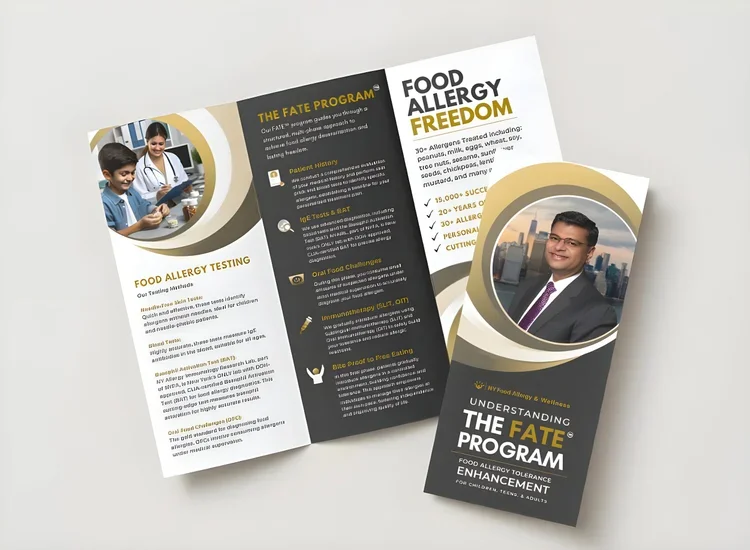
The FATE™ Program Brochure
Review the five-phase program, diagnostic tools, treatment options, and questions to bring to a consultation. The brochure is an overview, not a substitute for an individualized assessment.
Food Allergy Care in Manhattan
NY Food Allergy & Wellness provides food allergy evaluation and treatment at 110 East 60th Street, Suite 708, New York, NY 10022. A consultation can help determine whether the diagnosis is well established, what additional testing may add value, and whether desensitization fits the patient’s goals and medical profile.
Frequently Asked Questions
Food allergy desensitization is a medically supervised process that gives an eligible patient carefully measured amounts of an allergen according to a treatment protocol. The goal is to raise the amount that triggers symptoms. The protection generally depends on continued exposure or maintenance dosing and does not guarantee unrestricted eating.
No. Desensitization may raise a patient’s reaction threshold, but it is not considered a cure. Outcomes vary, continued dosing may be needed, reactions can still occur, and patients should continue the avoidance, epinephrine, and emergency-plan instructions provided by their allergist.
FATE™ stands for Food Allergy Tolerance Enhancement. It is NY Food Allergy & Wellness’s five-phase framework for clinical assessment, targeted testing, supervised food challenges when appropriate, individualized treatment, and long-term maintenance.
OIT uses measured amounts of allergen that are swallowed. SLIT places a smaller measured amount under the tongue. The routes, doses, evidence, practical demands, and treatment goals differ. An allergist should explain which options, if any, are reasonable for a particular patient.
There is no single timeline. Build-up can take months, and maintenance may continue long term. The schedule depends on the allergen, protocol, starting threshold, side effects, missed doses, illness, and treatment response. Faster is not automatically safer or better.
Not automatically. Patients generally continue to carry prescribed epinephrine, follow label-reading and cross-contact precautions, and maintain an emergency plan unless their treating allergist specifically changes those instructions.
Potential candidacy depends on a confirmed or well-supported diagnosis, the food involved, age, asthma control, gastrointestinal health, other medical conditions, treatment goals, and the ability to follow a dosing and safety plan. Evaluation by an experienced allergist is necessary.
Evaluation begins with the clinical history. Targeted skin testing, food-specific IgE, component testing, and BAT may add information in selected cases. A medically supervised oral food challenge may be used when the diagnosis or reaction threshold remains uncertain and the anticipated benefit justifies the risk.
About Atul N. Shah, MD, FACAAI, FAAAAI
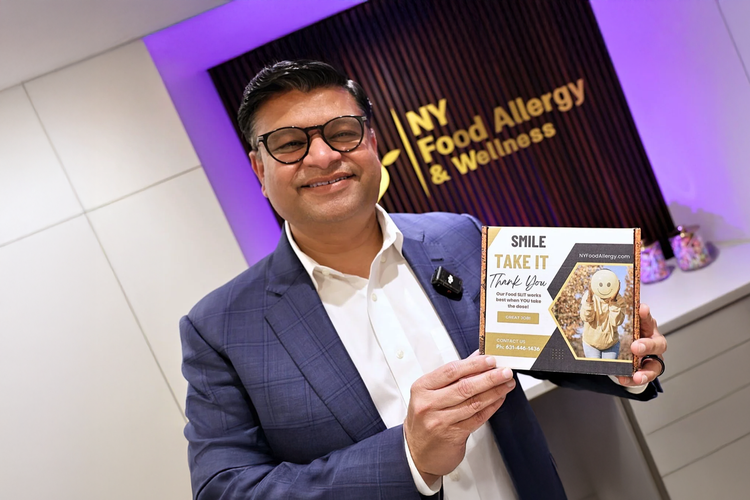
Dr. Atul Shah is a board-certified allergist and the founder of NY Food Allergy & Wellness. He evaluates children and adults with suspected or established food allergies and created the FATE™ Program as a structured pathway for diagnostic clarification, treatment planning, and long-term support.
- More than 20 years in allergy care
- Founder of NY Food Allergy & Wellness
- Creator of the FATE™ Program
- Fellow of the American College of Allergy, Asthma & Immunology
- Fellow of the American Academy of Allergy, Asthma & Immunology
Medical Sources and Further Reading
- American Academy of Allergy, Asthma & Immunology. The Current State of Oral Immunotherapy.
- American College of Allergy, Asthma & Immunology. Food Allergy Testing and Diagnosis.
- American Academy of Allergy, Asthma & Immunology. Food Allergy.
- NY Food Allergy & Wellness. The FATE™ Program.
- NY Food Allergy & Wellness. Oral Immunotherapy.
- NY Food Allergy & Wellness. Sublingual Immunotherapy.
- NY Food Allergy & Wellness. Basophil Activation Test.
- NY Food Allergy & Wellness. Oral Food Challenge.
This article is for education and does not replace individualized medical advice. If you may be experiencing anaphylaxis, use prescribed epinephrine and call 911.
