


Food Allergy Testing:
IgE Tests & Basophil Activation Test (BAT)
Dr. Shah combines standard IgE blood work with the Basophil Activation Test (BAT) to clarify which allergens are truly risky and which may be safer than they appear on traditional tests.
The Basophil Activation Test (BAT) is a blood test that measures the activation of basophils, a type of white blood cell, in response to specific allergens. This test is particularly useful in diagnosing food allergies and clarifying risk when other tests are confusing.
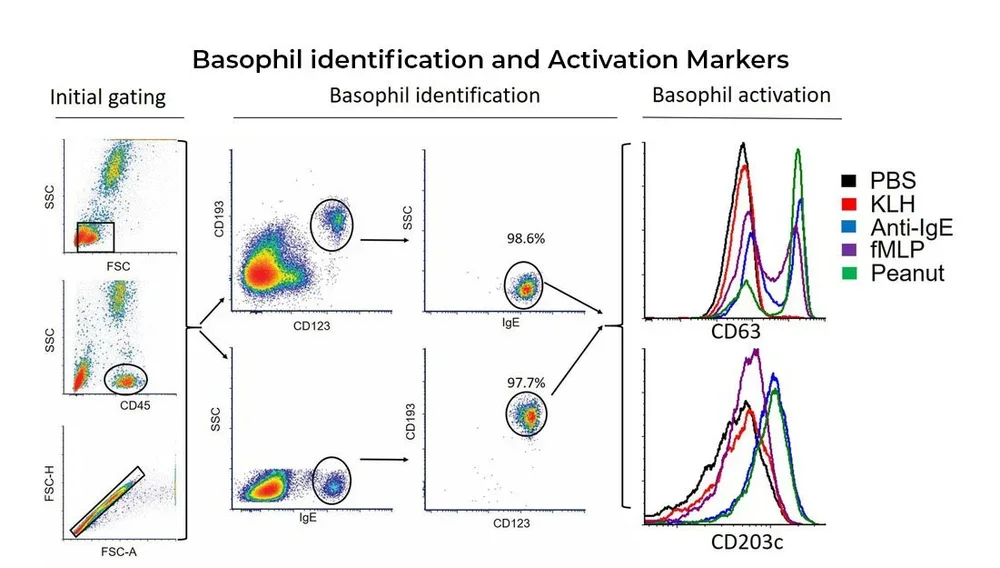
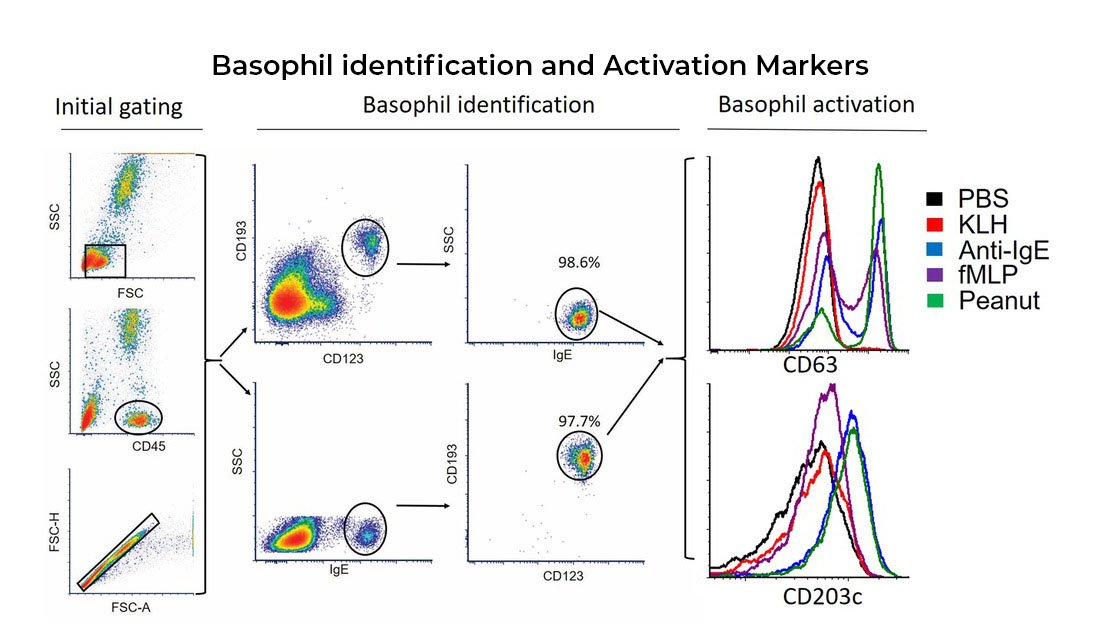
Basophil identification and activation markers from flow cytometry.
BAT process: In BAT, basophils are isolated from a blood sample and exposed to potential allergens. If the patient is allergic to a specific substance, the basophils activate. That activation is measured using flow cytometry.
BAT advantages: BAT is highly sensitive and is especially helpful when skin or IgE blood tests send mixed signals. It also carries minimal risk to the patient, because all of the testing happens in vitro, outside of the body.
NYAIRL, associated with NY Food Allergy & Wellness, is the first and only CLIA-certified laboratory in New York State to offer BAT for food allergy diagnostics. This makes NYFA a regional leader in advanced allergy testing and allows care plans to be based on highly precise, risk-aware data instead of guesswork.
Understanding the
Basophil Activation Test
Struggling with allergy symptoms and inconclusive tests? The Basophil Activation Test (BAT) safely detects allergen-specific immune responses and often provides clarity when traditional tests fall short. BAT supports accurate diagnosis for food, drug, and inhalant allergies and guides smarter management.
Accurate, Safer Diagnosis
When skin tests or sIgE are unclear, BAT measures functional basophil activation to the real-world allergen and clarifies true clinical allergy vs sensitization.
Flow Cytometry Precision
BAT uses flow cytometry to quantify activation markers (e.g., CD63, CD203c) on basophils, revealing IgE-mediated reactivity across food, inhalant, and drug allergies.
Guides Next Steps
Results help decide when to proceed with OFC, expand the diet, or personalize desensitization (Sublingual Immunotherapy/Oral Immunotherapy) timing and pace.
Accurate, Safer Diagnosis
When skin tests or sIgE are unclear, BAT measures functional basophil activation to the real-world allergen and clarifies true clinical allergy vs sensitization.
Flow Cytometry Precision
BAT uses flow cytometry to quantify activation markers (e.g., CD63, CD203c) on basophils, revealing IgE-mediated reactivity across food, inhalant, and drug allergies.
Guides Next Steps
Results help decide when to proceed with OFC, expand the diet, or personalize desensitization (Sublingual Immunotherapy/Oral Immunotherapy) timing and pace.
Ready to Speak With Our Care Team?
GET IN TOUCH
Fill out the form below to begin your journey towards Food Allergy Freedom. Our care team will respond shortly!


The Science Behind the Basophil Activation Test
The Basophil Activation Test (BAT) is a commonly used diagnostic tool for assessing the activation of basophils in an allergic response to allergens. It is considered a primary test for diagnosing Type I allergies, particularly in cases where routine clinical and laboratory analyses such as skin prick tests or sIgE measurements are inconclusive or pose risks, of reactions during the oral food challenge.
The BAT requires the incubation of allergy cells (basophils) and food allergens together in the lab setting to see how the cells will be affected by exposure to food allergens at various concentrations. This is like a Food Challenge, but done in the lab rather than exposing patients to allergenic foods.
To provide more precise information compared to measuring specific IgE concentrations, another advantage of BAT is its ability to evaluate IgE cross-linking, a key mechanism involved in understanding allergic diseases like food allergies. As this feature sets it apart from other methods available for food allergy diagnosis already, it has become one of the preferred approaches for accurately detecting food allergies.
IgE-Mediated Mechanisms
BAT functions by utilizing the IgE-mediated process, where allergens trigger the clustering of IgE antibodies on basophil surfaces. This results in their activation and subsequent release of inflammatory agents. In allergies, these specific antibodies generated by IgE play a crucial role as they create targeted defenses against common antigens while also contributing to allergic inflammation.
The binding of allergens to cell surface immunoglobulin receptors is responsible for facilitating this cross-linking process between food allergens, and IgE antibodies on basophils’ surfaces. Extensive research into food allergies has significantly advanced our understanding of this mechanism’s function in causing allergic reactions.
Applications of BAT in Allergy Diagnosis
The utilization of BAT (basophil activation test) is necessary in diagnosing various types of allergies, including food, inhalant, and drug allergies. Its function is to pinpoint the specific allergens causing a patient’s allergic symptoms, and serves as an alternative or supplementary method alongside traditional skin tests. It primarily detects sensitization on basophils, which indicates type I allergic reactions. This makes it particularly beneficial for identifying the responsible food allergen(s).
In detecting food allergy triggers, BAT mimics clinical manifestations experienced by allergic patients, while evaluating basophil activation through flow cytometry analysis and skin test that measures expression levels of cell surface markers indicating their activity state. This process proves especially valuable when determining proper treatment plans for children with known or suspected food allergies.
BAT also plays a crucial role in differentiating false positive allergy tests to clinically significant true food allergy. Through this diagnostic tool, a wider range of relevant factors clinical symptoms can be identified, bolstering the precision and effectiveness of overall allergy diagnosis methods.
Food Allergies
BAT plays a crucial role in diagnosing food allergies, mainly because of its high sensitivity and specificity. It also offers a lower risk profile for patients compared to other methods, making it an essential tool in identifying specific triggers of allergic reactions when traditional diagnostic techniques are inconclusive or dangerous.
Studies have shown the effectiveness of BAT in peanut-sensitized and other food allergic children. By detecting allergen-specific IgE antibodies, this test provides a safer alternative to oral food challenges where there is no need for patients to consume allergy-inducing foods that could potentially lead to anaphylaxis, one of the most severe forms of severe allergic reaction. This aspect becomes especially critical since oral food challenges carry inherent life-threatening risks despite being considered as one of the most accurate ways to diagnose food allergies.
Not only does BAT aid diagnosis managing food allergies, but can also help manage cases severe peanut and tree-nut allergy involving cross-reactivity – possible reactions caused by similar proteins found across different types of foods. Through consultation with our team, individuals can better understand these patterns and avoid related foods more accurately based on results from BAT tests which serve as precise tools indicating potential sensitivities due to potential similarities among certain ingredients. NYFA is the only food allergy center to have DOH approved and a CLIA certified lab to offer BAT in the State of New York.
Monitoring Treatment Outcomes with BAT
BAT not only aids in diagnosing allergies, but also plays a crucial role in monitoring the effectiveness of different treatments for food allergies like Sublingual Immunotherapy, Oral Immunotherapy, and desensitization protocols. It provides valuable insight into the patient’s response to these treatments. Research has shown in vitro tests that BAT can identify changes in basophil sensitivity during food SLIT & food OIT.
In managing IgE-mediated food allergies, BAT serves as an essential tool and sensitive marker for tracking treatment outcomes. Regular testing with BAT can effectively determine if a peanut and other food allergy treatment is working or needs adjustment. Studies have revealed that successful desensitization leads to significant reduction in basophil activation.
The success of desensitization protocols can be evaluated by measuring the decrease in basophil sensitivity to triggering substances after treatment is administered. This reduced sensitivity can be seen as early as 6 weeks and is typically noticeable after 12 months of Oral Immunotherapy (OIT).
Overall, regular use of BAT testing helps evaluate the efficacy of various allergy treatments such as OIT and management methods for IgE-mediated food allergies. Our NYFA team is finding more and more value with BAT results to make the food SLIT and food OIT safer and more efficient.
SCHEDULE TODAY
SCHEDULE TODAY


Ready to take control of your food allergies? Let our premier allergists guide you. Book your appointment today and start your journey to freedom together!
Oral Immunotherapy
BAT is utilized in the evaluation of immunotherapy’s effectiveness for various food allergies. It has proven useful in monitoring changes in basophil activation during the treatment process. The procedure involves measuring basophil degranulation after being stimulated with allergen or controls before and after immunotherapy, using flow cytometry to analyze the results.
By using flow cytometry to assess cellular levels of basophil activation following exposure to allergens, BAT allows for tracking any changes throughout immunotherapy treatment. This feature makes it a valuable tool for evaluating how effective this type of therapy is at modifying basophils’ activity levels over time.

Future Directions and Development
In the future, validation and standardization of the Basophil Activation Test present significant challenges, demanding rigorous test validation and standardization, including analytical validation, clinical validation, and standardization of procedures, for its complete integration into mainstream clinical practice. Recent developments, including improved clinical correlations with epitope mapping, are expanding the diagnostic capabilities of the BAT.
Significant advancements have been made in the selection of allergens for BAT, particularly in the context of food allergies. These advancements include improvements in the diagnosis and treatment of specific allergies such as egg allergy, where BAT demonstrates promising sensitivity and specificity results. The integration of automation into BAT procedures is being facilitated through the utilization of flow cytometry, which enables the assessment of the activation state of basophil cells at a single-cell level.
Passive BAT refers to a developing diagnostic approach that involves measuring the activation of basophils in the presence of an allergen to evaluate IgE function, demonstrating notable diagnostic precision. This method signifies a prospective avenue for enhancing food allergy diagnostics in the future.
NY Food Allergy & Wellness: NY's Only Certified BAT Allergy Lab
NY Food Allergy & Wellness has unique accreditations, setting it apart as the only lab in New York with both DOH approval and CLIA certification. This guarantees the reliability of their BAT testing methods and allows them to participate in clinical trials for new food allergy treatments. The CLIA certification also proves that the lab meets federal standards for processing human samples in a medical diagnostic context.
Specializing in clinical practice for identifying and treating food allergies, NY Food Allergy & Wellness offers comprehensive diagnostics along with advanced options like oral immunotherapy to effectively manage these allergies. Patients can conveniently take their allergy tests on-site at this facility. Some cases may require external labs to conduct blood or other types of tests.
Overall, patients with the most common food allergies and allergy symptoms benefit from cutting-edge treatment opportunities through NY Food Allergy & Wellness’s state-of-the-art services aimed at diagnosing and managing various food allergies. While onsite testing is available for our patients, we accept samples from other allergists and institutions to help their patients with BAT.

Frequently Asked Questions
What is the basophil activation test?
Utilizing flow cytometry, the basophil activation test (BAT) evaluates the presence of markers that indicate activation on blood basophils. This method can effectively detect both drug-induced basophil activation testing and allergen-triggered degranulation reactions.
What is basophil activation test for?
The BAT, also known as the basophil activation test, is a type of blood examination that aids in determining allergies to various food allergens like peanut, milk, eggs, wheat, soy, sesame, tree-nuts, fish, shellfish, and many more. It works by measuring the level of activated basophils when exposed to specific allergens. This method can effectively identify IgE antibodies related to true food allergies has shown direct correlation with histamine release.
What are the markers for basophil activation?
Two essential markers used in the diagnosis of IgE-mediated allergies through the Basophil activation test (BAT) are CD63 and CD203c. Screening for these specific biomarkers is imperative to accurately identify IgE-mediated allergies using BAT.
What does a food allergist do?
A food allergist tests for food allergies, identifies triggers for allergies, and prescribes medications for severe allergic reactions and asthma. Our NYFA team’s food allergy experts help patients find options beyond food avoidance and can personalize the treatment plan with food SLIT and food OIT. It’s crucial to consult our team to determine the existence of food allergies and receive appropriate management for severe reactions.
How does BAT work?
BAT operates via the process of IgE-mediated mechanisms, in which allergens stimulate basophils and prompt them to release inflammatory mediators by binding with IgE antibodies.
Who can perform the Basophil Activation Test?
NY Food Allergy & Wellness has unique accreditations, setting it apart as the only lab in New York with both DOH approval and CLIA certification. This guarantees the reliability of their BAT testing methods and allows them to participate in clinical trials for new food allergy treatments. The CLIA certification also proves that the lab meets federal standards for processing human samples in a medical diagnostic context. Dr. Atul Shah and his team at NY Food Allergy & Wellness have 3 offices. Locations on Long Island: Centereach and Shirley. Manhattan: 110 E 60th Street. Please visit https://www.center4asthmaallergy.com/ for locations on long island. And visit https://www.nyfoodallergy.com/ for our Manhattan location.
Where can I learn more about Oral Immunotherapy?
You can learn more about the Oral Food Challenge, as well as all of the food allergy treatment options by watching success stories on our YouTube channels. NY Food Allergy & Wellness and Center4Asthma&Allergy.
Where can I learn more about Dr. Atul Shah?
There are several ways to learn more about Dr. Atul Shah. Follow these links for more detailed information, including interview by WABC and News 12. Health.usnews, healthgrades, doximity, center4asthma, OIT101, NYULangone, Sharecare, Medicalnewstoday, Matherhospital, NPIdb, PatientFusion, MD.com, Medifind, Spacial Health, Amerimmune.
Where can I find more information about the Oral Immunotherapy and Food Allergist content on Social Media?
You can find more information on all treatments, including success stories and more on Instagram, Facebook, TikTok, YouTube and Amazing Allergist.