

Food Allergy Parenting Guide
Raising a Child With Food Allergies: A Parent's Guide
Practical guidance for school, childcare, parties, nutrition, emotional well-being, emergency planning, and deciding whether supervised testing or treatment may fit your child.

Jump to a section
The quick answer
The goal is not to remove every uncertainty from childhood. It is to build a reliable safety system while helping your child develop confidence, good judgment, and age-appropriate independence. That system should include an accurate diagnosis, a written emergency plan, accessible prescribed medication, prepared caregivers, and regular follow-up with an allergist.
Safety and participation belong together. A child should not have to choose between being protected and being included. Good planning addresses both.
First priorities after a food allergy diagnosis
New diagnoses often produce a rush of restrictions, questions, and fear. Slow the process down enough to separate what is confirmed from what is only suspected.
Confirm the allergy picture
Review what was eaten, timing, symptoms, treatment, and prior tolerance. Skin and blood tests can support a diagnosis, but false positives occur and results must be interpreted with the history. [4]
Create a written emergency plan
List the confirmed allergens, expected symptoms, prescribed medication instructions, emergency contacts, and the steps another adult should follow.
Keep medication accessible
Know where prescribed epinephrine is at home, school, activities, and during travel. Check expiration dates and practice with a trainer device when available.
Use consistent handoffs
Babysitters, relatives, coaches, teachers, drivers, and camp staff need the same clear information rather than different versions of the plan. [9]
Build a food allergy plan for school and childcare
CDC guidance emphasizes both daily management and emergency readiness. A plan should work beyond the nurse's office, including classrooms, cafeterias, transportation, field trips, after-school programs, and substitute-teacher days. [1] [2]
Before the year begins
- Provide a current clinician-signed emergency care plan
- Confirm the child's allergens and prescribed medications
- Identify who receives and updates the medical information
- Discuss meals, classroom food, celebrations, crafts, and field trips
Confirm the emergency pathway
- Where medication is kept and how quickly it can reach the child
- Which adults are trained and who covers their absence
- How staff contact emergency services and the family
- How the plan follows the child during transportation and activities
Build independence one skill at a time
A child should gain responsibility gradually. Age alone is not the only factor. Development, maturity, reaction history, school environment, and the child's ability to recognize symptoms all matter.
Find a trusted adult
Learn the allergen's name, avoid food sharing, and tell an adult before eating something unfamiliar.
Practice simple scripts
Ask whether food is safe, identify early symptoms, and understand that medication must stay nearby.
Share responsibility
Practice label reading, school-lunch decisions, activity planning, and speaking up around friends.
Prepare for independence
Plan for restaurants, dating, travel, sports, jobs, risk-taking, and consistent medication carrying.
A useful parenting shift: move from doing every safety task for your child to watching them perform the task correctly, then stepping back only when the skill is reliable.
Plan for parties, sports, camp, restaurants, and travel
Participation does not require pretending the risk is zero. It requires knowing the risk, deciding what controls are realistic, and identifying the adult responsible for the plan.
Birthday parties
Contact the host early, ask what food and activities are planned, send a safe alternative when needed, and make sure the supervising adult understands the emergency plan.
Sports and after-school activities
Medication and the care plan should travel with the child. Coaches and program staff should know the symptoms, response steps, and who calls emergency services.
Camp
Review dining, medication access, staff training, trips away from camp, communication, and distance to emergency care. A school plan should not simply be copied without adapting it. [10]
Restaurants and travel
Research ahead, ask focused questions, carry backup food when appropriate, keep prescribed medication accessible, and avoid placing the entire safety burden on the child.
Protect emotional well-being, not only physical safety
Children may feel different, embarrassed, frustrated, excluded, or afraid of another reaction. Parents and caregivers can also carry persistent stress. These responses are understandable, but they deserve attention when they begin controlling daily life. [8]
Watch the pattern, not one difficult day
- The safe-food list keeps shrinking without medical evidence
- School, parties, travel, or restaurants are repeatedly avoided
- Meals trigger panic, conflict, or prolonged reassurance
- Sleep, mood, concentration, or independence is affected
NYFA's role is food allergy medicine. An allergist can clarify the medical risk and plan. A pediatrician, dietitian, psychologist, or other qualified professional may also be needed when nutrition, anxiety, trauma symptoms, or restrictive eating are affecting function.

Protect nutrition, growth, and variety
Avoiding a confirmed allergen is appropriate. Avoiding foods because of broad panel results, family assumptions, or cross-reactivity fears that have not been clinically evaluated can unnecessarily narrow a child's diet.
Questions to review
- Is each avoided food supported by the history and testing?
- Are major nutrients being replaced appropriately?
- Is the child growing along their expected pattern?
- Are safe foods varied enough for school, travel, and social life?
When more support helps
- Multiple staple foods are excluded
- Weight, growth, energy, or nutrient intake is a concern
- Feeding difficulty or extreme selectivity is expanding
- The family needs practical substitutions and meal planning
Children are particularly vulnerable to the nutritional risks of elimination diets. Nutritional counseling and growth monitoring may be appropriate when one or more important foods are removed. [7]
Make emergency readiness simple enough to use
In an emergency, a short practiced plan is more useful than a long document nobody remembers. Follow the child's individualized instructions.
Recognize
Know the symptoms listed in the child's plan and teach age-appropriate symptom language.
Treat
When anaphylaxis is suspected, prescribed epinephrine is the first-line treatment and should not be delayed for antihistamines.
Escalate
Call 911 and seek emergency medical care according to the child's plan after administering epinephrine.
Review
After a reaction, follow up with the allergist to reassess the trigger, medication, and prevention plan.
Do not wait for every possible symptom. Anaphylaxis can progress quickly. Use the prescribed plan and seek emergency care. [11]
Accurate testing can prevent unnecessary restriction
A positive skin or blood test can show sensitization without proving that eating the food causes symptoms. NYFA reviews the reaction history and uses targeted testing to determine what is confirmed, what is unlikely, and what may still need supervised clarification. [4]
Never perform an oral food challenge at home. The OFC is an important diagnostic tool and must be conducted in a setting prepared to recognize and treat reactions. [5]

How the FATE™ Program organizes evaluation and treatment
FATE™ stands for Food Allergy Tolerance Enhancement. It is NYFA's structured framework for moving from diagnostic uncertainty toward an individualized plan. Not every child needs every step, and no phase guarantees unrestricted eating.
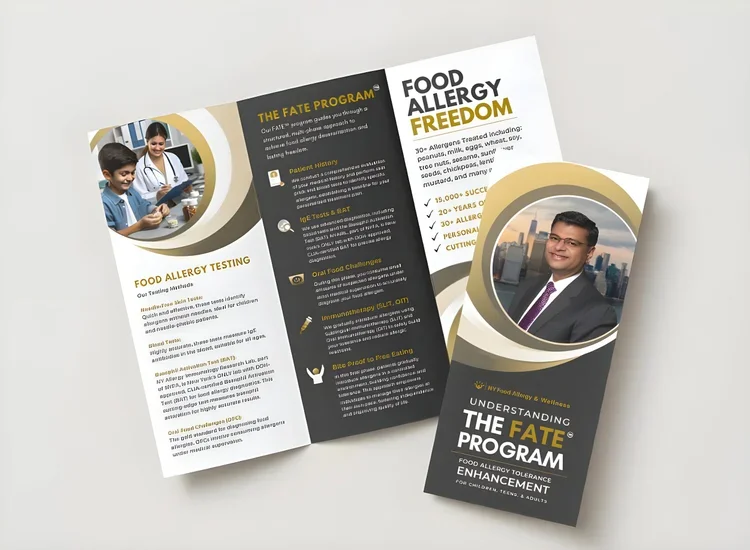
Desensitization is not a cure and is not risk-free. OIT aims to raise the reaction threshold while ongoing exposure continues. Reactions, gastrointestinal symptoms, daily dosing, activity rules, and long-term follow-up are part of the decision. [6]
What progress can mean for a child and family
Progress should be measured against the family's starting point and the child's medical plan, not someone else's testimonial.
Unclear restrictions
Several foods are avoided because of old testing, incomplete records, or fear of cross-reactivity.
Supported directionClarify which foods truly require avoidance and which uncertainties need supervised evaluation.
Every activity feels unsafe
Parties, school events, restaurants, or travel are declined automatically.
Supported directionUse a specific plan to decide what can be approached safely and where extra controls are still needed.
The parent carries every task
The child has little opportunity to practice communication or emergency skills.
Supported directionTransfer one responsibility at a time while an adult verifies that the skill is reliable.
Potential is not a promise. Testing and treatment may improve clarity, confidence, protection, or dietary flexibility for some families. Outcomes, timelines, burdens, and maintenance requirements vary.
Learn more about treatment and family decision-making
Use these resources to understand the process before deciding whether a consultation or treatment discussion is appropriate for your child.
About Dr. Atul Shah

Clear diagnosis, realistic plans, and individualized treatment decisions
Atul N. Shah, MD, FACAAI, FAAAAI, is the founder of NY Food Allergy & Wellness. NYFA describes Dr. Shah as having more than 20 years of experience caring for children, teens, and adults with food allergies.
For families, his role is to clarify the allergy picture, reduce avoidable restrictions, prepare for emergencies, and discuss testing or treatment options without assuming that one path fits every child.
Food allergy care for children in Manhattan
NY Food Allergy & Wellness is located on the Upper East Side at 110 East 60th St., Suite 708, New York, NY 10022.
Frequently asked questions
Give the school a current, clinician-signed emergency plan; confirm where prescribed epinephrine is stored and who can administer it; review meals, classroom activities, field trips, transportation, and after-school programs; and update the plan whenever the diagnosis or medication changes.
It should identify the confirmed allergens, describe possible symptoms, state when and how prescribed medication should be used, list emergency contacts, explain medication access, and address routine prevention and emergency response across the places your child spends time.
Use age-appropriate skills. Young children can learn the names of their allergens, avoid food sharing, and find a trusted adult. Older children can practice label reading, restaurant questions, symptom reporting, medication responsibility, and how to speak up without embarrassment.
They can affect emotional well-being through reaction fear, social exclusion, repeated planning, and loss of spontaneity. Not every worry is a disorder. Additional support is appropriate when anxiety or avoidance interferes with eating, sleep, school, relationships, travel, or age-appropriate independence.
Talk with the host early, ask focused questions about food and activities, send a safe alternative when needed, make sure prescribed medication follows the child, and agree on which adult is responsible. The goal is safe participation, not automatic exclusion.
Desensitization can be appropriate for selected children, but it is not risk-free. Reactions can occur during treatment, and the dosing route, goals, medical history, daily schedule, and family preferences all matter. An experienced allergist should determine whether the potential benefits justify the burdens and risks for that child.
No. Oral immunotherapy aims to raise the amount of allergen that triggers a reaction while treatment continues. Children generally still need an emergency plan, prescribed epinephrine, label awareness, and ongoing follow-up. Unrestricted eating and permanent tolerance should not be assumed.
Some childhood food allergies are more likely to resolve than others. A child should not test this at home. An allergist may use the reaction history, targeted testing, and sometimes a medically supervised oral food challenge to determine whether tolerance has developed.
Follow the child's prescribed emergency plan. When anaphylaxis is suspected, epinephrine is the first-line treatment and should be given promptly, followed by emergency medical care. Antihistamines do not replace epinephrine for anaphylaxis.
NYFA can review the child's history and prior testing, clarify which foods are truly implicated, build a medical and emergency plan, and discuss supervised testing or treatment options when appropriate. Recommendations are individualized and do not guarantee a particular threshold or lifestyle outcome.
Sources and related reading
Continue reading on NYFA
This article provides general education and does not diagnose a food allergy or determine an emergency or treatment plan. Follow your child's individualized instructions. Do not introduce a suspected allergen, perform an oral food challenge, or begin desensitization without guidance from a qualified clinician. Possible anaphylaxis requires prompt treatment with prescribed epinephrine and emergency medical care according to the child's plan.
